The expansion of commercial driverless robotaxis and Level 3/Level 4 automated driving systems across California urban centers—from San Francisco and San Jose to Los Angeles and San Diego—has fundamentally altered street traffic mechanics. While proponents highlight automated driving technology as a path toward reducing human error, autonomous vehicle (AV) testing and fleet deployments have resulted in severe traffic incidents, including catastrophic collisions with pedestrians, cyclists, and other passenger motor vehicles. Due to sudden braking failures, perception software glitches, or delayed remote operator interventions, victims involved in driverless car crashes frequently suffer severe traumatic brain injuries (TBIs).
To establish accountability across the commercial autonomous transit sector, California enacted landmark legislation: Assembly Bill 1777 (AB 1777). Taking full effect on July 1, 2026, AB 1777 establishes groundbreaking compliance rules for driverless vehicle manufacturers, creates direct citation mechanisms for traffic code violations, mandates strict emergency responder communications, and standardizes black-box telemetry data retention. For personal injury attorneys and victims of brain trauma, AB 1777 significantly reshapes the legal framework for proving liability and recovering severe TBI damages in California courts.
How AB 1777 Changes Liability in Driverless Car Collisions

Historically, when a vehicle equipped with autonomous driving technology caused a motor vehicle crash, insurance defense teams exploited regulatory ambiguities regarding whether the human passenger, the remote fleet operator, or the software developer bore legal responsibility. AB 1777 eliminates much of this evasive maneuvering by establishing clear statutory accountability under the California Vehicle Code.
Direct Citations and Non-Compliance Reporting
Under AB 1777, if a fully driverless vehicle (operating without a human driver physically in the driver’s seat) commits a violation of the California Vehicle Code, law enforcement officers can issue a formal notice of non-compliance directly to the AV manufacturer. Manufacturers are required to report these notices to the California Department of Motor Vehicles (DMV) within 72 hours. This statutory linkage ensures an official law enforcement record of the AV’s driving infraction, establishing crucial evidence of negligence per se or product non-compliance in personal injury litigation.
Remote Operator Accountability and 30-Second Emergency Standards
For vehicles operating without an onboard driver, AB 1777 requires manufacturers to maintain a dedicated, two-way voice communication system and an emergency response hotline monitored continuously by remote human operators. Remote operators must be capable of answering emergency responder calls within 30 seconds and possessing immediate situational awareness to immobilize, reroute, or manually direct the vehicle away from an emergency zone. In brain injury lawsuits, failure of a remote operator to intervene within established timeframes can expose both the operating company and the manufacturer to direct negligence and vicarious liability claims.
Mandatory Telemetry Data Retention: Unlocking Black-Box Evidence
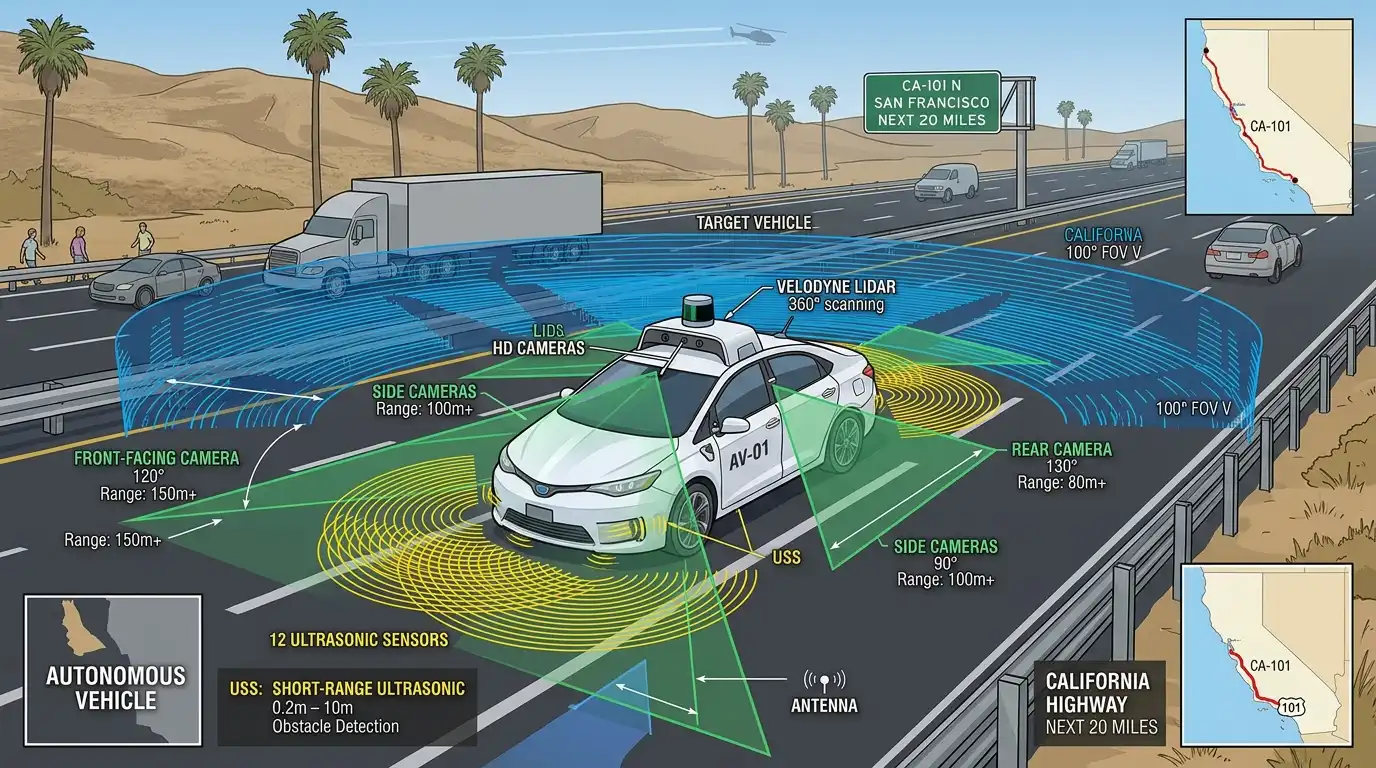
Establishing liability in a traditional car accident often relies on eyewitness testimony and skid-mark reconstruction. In an autonomous vehicle TBI lawsuit, however, the central battleground revolves around digital telemetry—the massive streams of data generated by LiDAR, millimeter-wave radar, optical cameras, ultrasonic sensors, and deep-learning neural network perception layers.
AB 1777 codifies vital evidentiary protections by amending California Vehicle Code Section 38750. The statute requires all autonomous vehicle manufacturers to equip vehicles with a dedicated, separate mechanism that captures and stores autonomous technology sensor data in a read-only format for at least 30 seconds prior to any collision. This mandatory pre-crash recording preserves critical data points:
- Object Perception & Classification Logs: Proving whether the AV’s perception system correctly identified a pedestrian, cyclist, or vehicle or misclassified them as background noise.
- Bounding Box & Velocity Trajectories: Showing the exact moment the AV algorithm calculated an impending impact and whether hard braking was initiated or delayed.
- Remote Human Intervention Timelines: Documenting whether a remote assistant issued override commands or if latency prevented timely collision avoidance.
- System Disengagement Records: Verifying if the automated driving system attempted to disengage milliseconds before impact to transfer control to an inactive human passenger.
California AB 1777 Legal Framework vs. Traditional Motor Vehicle Tort Law
| Legal Aspect | Traditional Vehicle Collision Claims | Autonomous Vehicle TBI Claims under AB 1777 |
|---|---|---|
| Primary Defendant | Individual human driver / vehicle owner | AV Manufacturer, software developer, or fleet operator |
| Traffic Citation Target | Human driver at the scene | AV Manufacturer cited via Notice of Non-Compliance sent to CA DMV |
| Key Evidentiary Source | Eyewitnesses, police report, skid marks | Read-only pre-crash 30-second sensor telemetry & perception logs |
| First Responder Response Mandate | Standard roadside assistance / emergency services | 2-way voice device & dedicated operator reachable within 30 seconds |
| Legal Theories of Liability | General driver negligence (CVC violations) | Strict product liability, software design defect, & statutory non-compliance |
Navigating Complex Traumatic Brain Injury Damages in AV Litigation
 Because autonomous vehicles range in curb weight from standard passenger sedans to heavy electric shuttle platforms, high-speed impact forces transfer extreme kinetic energy to the human cranium. Traumatic brain injuries resulting from AV collisions frequently include coup-contrecoup cerebral contusions, traumatic subarachnoid hemorrhages, and diffuse axonal injury (DAI) caused by violent acceleration-deceleration shearing forces.
Due to the complex, corporate nature of autonomous vehicle defendants, securing full compensation requires presenting undeniable, objective medical proof of brain damage:
- Advanced Neuroimaging (3T DTI & SWI): Diffusion Tensor Imaging (DTI) and Susceptibility Weighted Imaging (SWI) map disruption in cerebral white matter tracts that standard CT scans fail to detect.
- Quantitative Neuropsychological Profiling: Formal testing documenting executive dysfunction, processing speed impairment, short-term memory deficits, and emotional dysregulation.
- Life Care Planning & Economic Modeling: Calculating long-term economic damages, including multi-decade cognitive rehabilitation, occupational therapy, 24/7 attendant care, and diminished lifetime earning capacity.
Overcoming Corporate Defense Tactics in Driverless Car Lawsuits
Autonomous vehicle manufacturers and their defense firms defend personal injury claims aggressively, often claiming trade secret protection over proprietary sensor algorithms or arguing that unexpected roadway conditions constituted an unforeseeable event. AB 1777 equips California plaintiff attorneys with clear statutory mandates to defeat these delay tactics through early spoliation letters, immediate court orders for raw sensor extraction, and detailed subpoenas for DMV non-compliance records.
When an autonomous vehicle fails to operate safely on California roadways, holding the manufacturer accountable under AB 1777 ensures that injured victims receive the specialized medical care and financial recovery needed to rebuild their lives after a catastrophic traumatic brain injury.